Johnston Sisters Sing an Ojibwe Sweetheart Song
To celebrate Women’s History Month and Poetry month in 2026, Curator & Public Historian, Barbara Bair assembled an exhibit of the work of Jane Johnston Schoolcraft at the Library of Congress.
Bamewawagezhikaquay (Woman of the Sound the Stars Make Rushing Through the Sky) began writing poetry in English and Ojibwemowin and as Bair notes: “her poems reflect her love of nature and the songs, tales, and history of her Indigenous heritage.
They also explore hope, faith, and delight, and the pain of grief, loss, and separation.
One of the songs Jane transcribed and translated is Ojibwe Ikwezens which was sung often by both Jane and her sister Charlotte.

Project: The Ojibwe Ikwezens Song Moving Across Time
This song has traveled across generations. Here we share part of its journey in four stages. Explore each part below.
- 1Part 1: In the early 1800s Jane Johnston Schoolcraft transcribes the song in her journals. These journals have been preserved by the Library of Congress, and you can see her original transcription below.
- 2
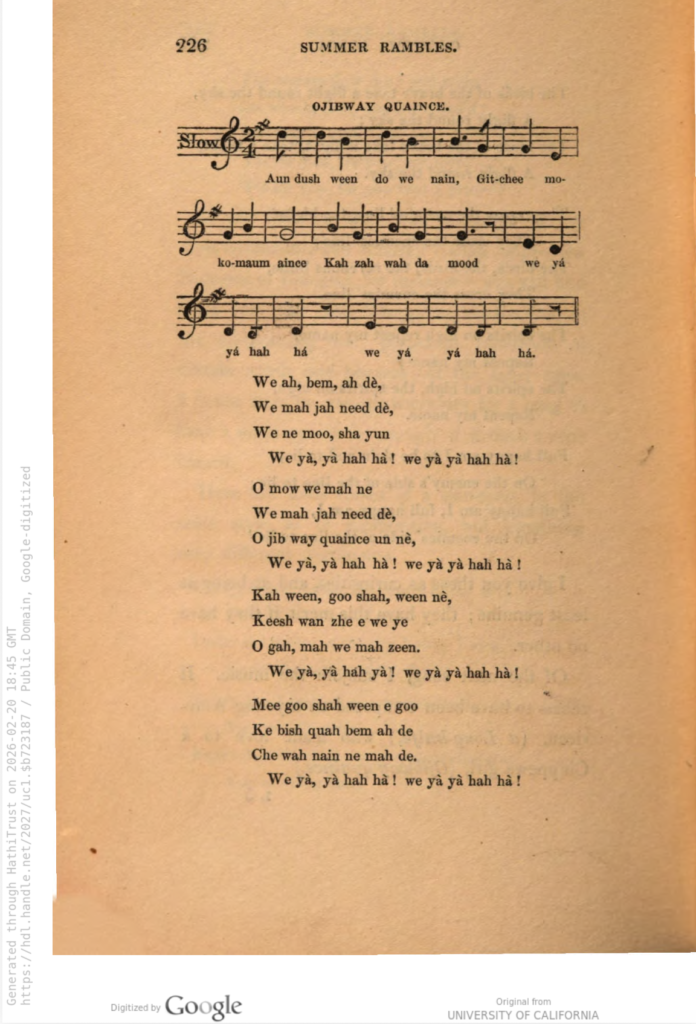
Part 2: Anna Jameson hears Jane and her sister Charlotte singing the song in her travels to Sault Ste. Marie in 1837. She notates the music as she heard it at the time. Her musical score appears in her book Winter Studies and Summer Rambles.
- 3Part 3: Margaret Noodin converts the writing into modern-day Ojibwe orthography and provides a literal translation for students of the language.
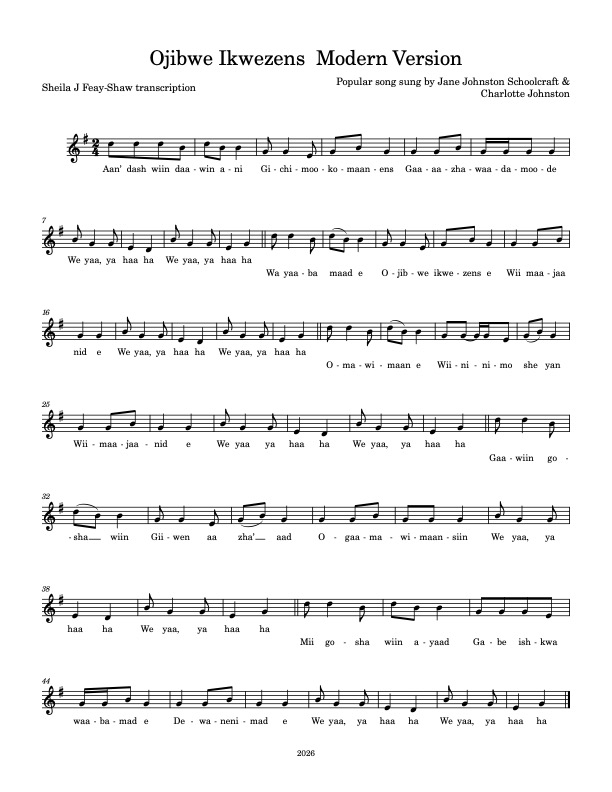
- 4Part 4: Margaret Noodin, Sheila Feay-Shaw, and Róisín Ní Raghallaigh record the song. Fear-Shaw then transcribes the recording so you can sing along.
Part 1: The lyrics as Jane transcribed them
From 1815 until about 1830 Jane transcribed the words to Ojibwe Ikwezens, a popular song of the time. This writing was preserved in the Library of Congress collection.
1.
Aun dush ween do win ane
Gitchy Mocomaun aince
Caw awzhaw woh da modé
We yea, yea haw ha! &c
2.
Wah yaw bum maud e
Ojibway quaince un e
We maw jaw need e
We yea, yea haw ha! &c
3.
Omow e maun e
We nemoshain yun
We maw jaw need e
We yea, yea haw ha! &c
4.
Caw ween gush shá ween
Kin wainzh e we yea
O guh maw e maw seen
We yea, yea haw ha! &c
5.
Me gosh shá ween e yea
Ke bish quaw bam maud e
Tehe won ain e maud e
We yea, yea haw ha! &c
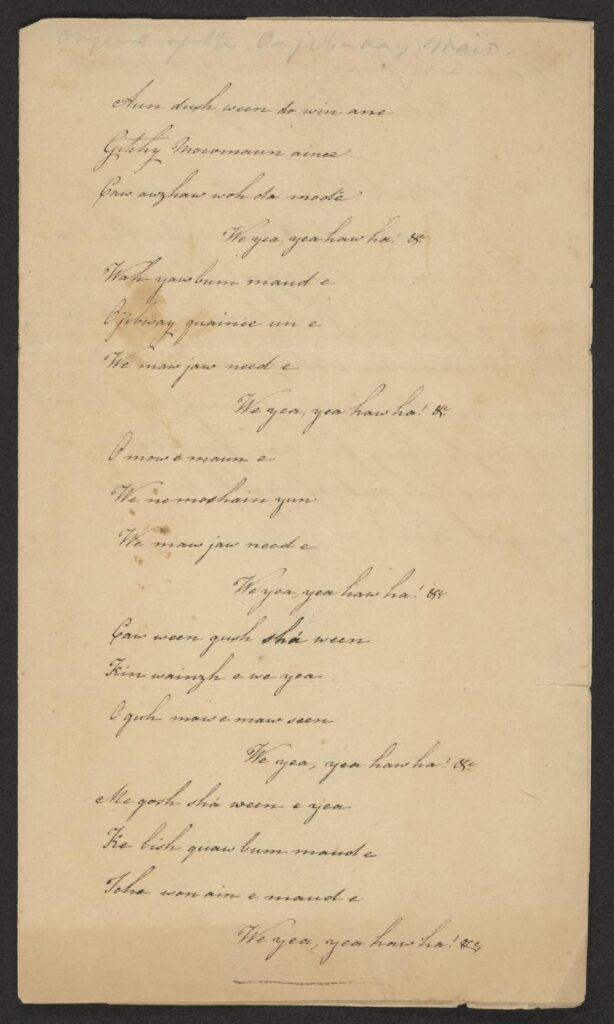
Song lyrics as written by Jane Johnston Schoolcraft online at Library of Congress:
https://www.loc.gov/resource/mss39115.07025/?sp=3
Part 2: Jane’s Re-telling of the Story in Prose & Anna Brownell Jameson’s Musical Score
Jane’s lovely retelling of the story in prose:
Why! What’s the matter with the young American? He crosses the river with tears in his eyes! He sees the young Ojibway Girl preparing to leave the place: he sobs for his sweetheart, because she is going away! but he will not sigh long for her, for as soon as he sees her out of sight, he will forget her.
The first known score of the song recorded by Anna Brownell Jameson in her book Winter Studies and Summer Rambles in Canada published in 1838 in which she says Ojibwe songs ought to be compared with the Notturini of Felice Blangini (1781, Turin – 1841, Paris) due to their repetition and focus on sentiment over extensive detail.
Note: Anna Brownell Jameson, was a scholar, artist, art historian and feminist born in Dublin, Ireland in 1794. In 1837 she traveled through several Anishinaabe communities in southern Ontario. The book that established her reputation as a scholar was Characteristics of Women, Moral, Poetical and Historical (1832), later titled Shakespeare’s Heroines and still cited by researchers today.
Part 3: The song is translated in 2026
Text here about the translation process.
Translated into modern Ojibwe
1.
Aan’ dash wiin daawin ani
Gichi-mookomaanens
Gaa-aazhawaadamoode
We yaa, ya haa ha (repeat)
2.
Wayaabamaad e
Ojibway ikwezens e
Wii-maajaanid e
We yaa, ya haa ha (repeat)
3.
Omawimaan e
Wiininimosheyan
Wii-maajaanid e
We yaa, ya haa ha (repeat)
4.
Gaawiin gosha wiin
Giiwenaazha’aad
Ogaa-mawimaansiin
We yaa, ya haa ha (repeat)
5.
Mii gosha wiin ayaad
Gabe ishkwa waabamad e
De-wanenimad e
We yaa, ya haa ha (repeat)
The literal translation
1.
Why is he in his camp there
The young American
He has crawled across the river
We yaa, ya haa ha (repeat)
2.
He sees her
The Ojibway maiden
She will leave
We yaa, ya haa ha (repeat)
3.
He cries for her
His sweetheart
She will leave
We yaa, ya haa ha (repeat)
4.
It is not really
That he will dismiss her
He will not be crying for her
We yaa, ya haa ha (repeat)
5.
When he is there
At the end of seeing her
He will forget her
We yaa, ya haa ha (repeat)
Part 4: The song is revitalized and you can sing it too!
Sheila Feay-Shaw, Róisín Ní Raghallaigh and Margaret Noodin from, Milwaukee, Béal Feirste, and Gichi-Onigaming sang a
version of the song together in 2026.
In singing the original transcribed version of this song, there were several concepts that did not reflect the sense of traditional Ojibwe songs. Since the original came from a time period where Western traditional musical practice would have greatly influenced the documentation of the song, and since no recording was used to help with memory of the specific musical elements, a new transcription has been created. This one utilizes as much of the original melodic material as possible adding in more traditional rhythmic patterns and logical language alignment. The spirit of the original transcription has been maintained while creating a version that more closely aligns with the sound of Ojibwe traditional songs.
Play Audio: Ojibwe Ikwezens 3